THE SECOND BOOK OF MOSES, CALLED
NAMES
שְׁמוֹת
⇐
Parashat Shemot | Parashat Va'eira | Parashat Bo | Parashat Beshalach | Parashat Yitro | Parashat Mishpatim | Parashat Terumah | Parashat Tetzaveh | Parashat Ki Tissa | Parashat Vayakhel | Parashat Pekudei
[...]
Translation in progress.
And these are the names of the sons of Israel, who came to Egypt with Jacob, each man and his household came:
Reuben, Simeon, Levi and Judah;
Issachar, Zebulun and Benjamin;
Dan and Naphtali;
Gad and Asher.
All those who were descendants of Jacob were seventy, for Joseph was already in Egypt.
Now Joseph, his brothers and all that generation died. But the sons of Israel were fruitful, increased abundantly, multiplied and grew exceedingly in abundance; the land was filled with them.

Then a new king, who didn't know about Joseph, rose to power in Egypt.
— Look, — he said to his people — the Israelis are in large numbers and are mightier than us. Come, let's be smart with them, or else they'll multiply and, if a war breaks out, they'll join our enemies and fight against us and leave the land.
So they set taskmasters to afflict them with their burdens. And they built supply cities for Pharaoh: Pithom, Pi-Ramesses and Iunu, which is Heliopolis. But the more they afflicted them, the more they multiplied and increased greatly, and the Egyptians abhorred the Israelites even more. So Egypt made Israel serve severely and made their lives bitter with hard service in mortar and brick, and with all types of service in the fields. All service the Egyptians commanded them to do was with harshness. They continued to multiply and increase greatly, and Egypt was afraid because of the Israelites.
Then the king of Egypt said to the midwives of the Hebrews, whose names were Siphrah and Puah:
— When you help the Hebrew women give birth, see them on the birthstools. If it is a son, then you'll kill him, but if it is a daughter, then she'll live.
But the midwives feared God and didn't do as the king of Egypt commanded them, and let the boys stay alive. So the king of Egypt called for the Hebrew midwives and said to them:
— Why have you done this thing and let the boys stay alive?”
The midwives said to Pharaoh:
— The Hebrew women are not like the Egyptian women, because they are lively and, before the midwives come to deliver them, they give birth.
So God was good to the midwives, and He multiplied the people and they grew very mighty. And so because the midwives feared God, He provided families for them.
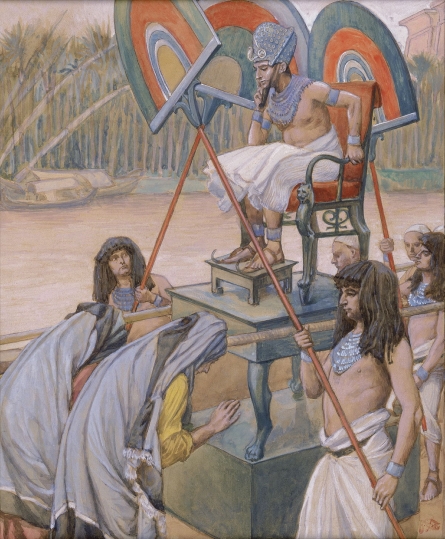
So Pharaoh commanded all his people:
— Every son who is born, you shall cast into the river, and every daughter, you shall let them stay alive.
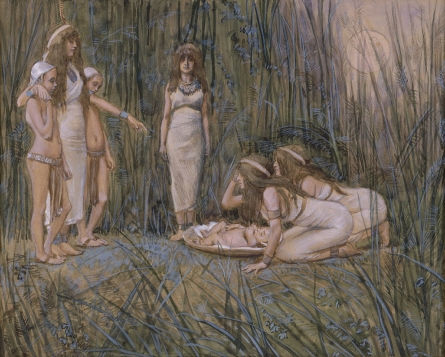
A Levite man went and married a Levite woman. She became pregnant and gave birth to a son. When she saw that he was good, she hid him for three months. But when she couldn't hide him any longer, she made him a papyrus ark and fermented it with asphalt and pitch. Then she put the child in the ark.
— Go — she told her maidservant and then she laid it in the reeds by the bank of the Nile.
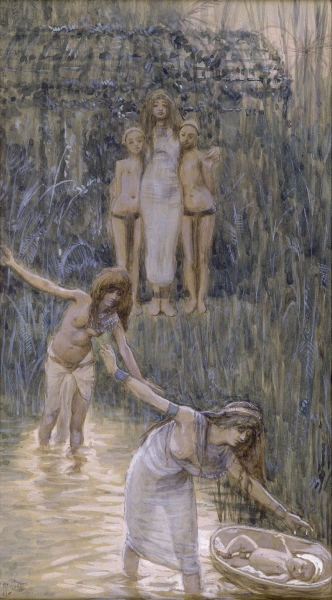
Then Pharaoh's daughter came to bathe in the Nile and her maidens walked along the side of the Nile. When she saw the ark among the reeds, she sent her handmaid to take it. And when she opened it, she saw the child and look! the little boy wept.
So Pharaoh’s daughter had compassion on him and said:
— This is one of the Hebrew children.
The baby's sister said to her:
— Should I go and call a nurse from the Hebrew women so she may nurse the child for you?
— Go — she said.
So the young girl went and called the boy's mother. And Pharaoh's daughter told her:
— Take this boy and nurse him for me, and I'll pay your salary.
So the woman took the boy and nursed him. When the child grew up, she brought him to Pharaoh's daughter and he became her son. So he called him Moses and explained:
— I drew him out of the waters.
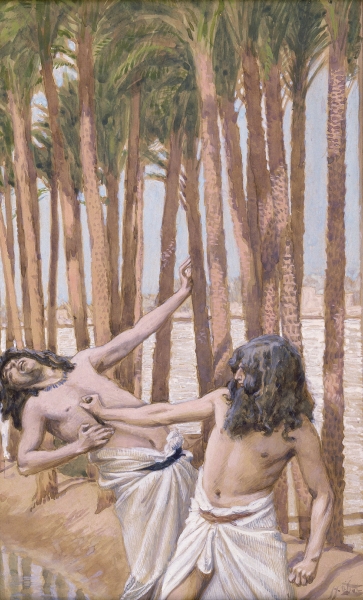
Many years later, when Moses had grown up, when he went out to his brothers and saw their burdens, he noticed an Egyptian beating a Hebrew of his brothers. So, after looking in all directions and seeing no one around, he killed the Egyptian and hid him in the sand.
The next day, he went out and saw two Hebrew men fighting each other. He said to the one in the wrong:
— Why are you attacking your friend?
But the man replied:
— Who made you prince and judge over us? Are you going to kill me like you killed the Egyptian?
Moses was very scared and said:
— Now they know what I’ve done for sure.
When Pharaoh heard of this, he sought to kill Moses, but he fled from Pharaoh and dwelt in the land of Midian, where he sat down by a well.

Now the priest of Midian had seven daughters, shepherdess of his flock. They came, drew water and filled the troughs to give their father's flock to drink. When shepherds came and drove them away, Moses stood up and helped them and watered their flock. The girls went to Reuel, their father. He said:
— Why have you returned so early today?
They said:
— An Egyptian man saved us from the shepherds. He even drew water for us and gave the flock to drink.
Then Reuel said to his daughters:
— So where is he? Why did you leave the man there? Call him to eat some bread.
So Moses started living with Reuel. He gave his daughter Zipporah to Moses. She bore him a son and he called him Gershom, explaining:
— I have been a stranger in a strange land.
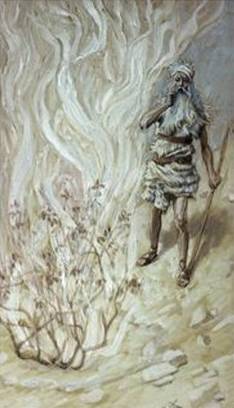
Meanwhile Moses was tending the flock of Jethro, his father-in-law, the priest of Midian, and, leading the flock behind the desert, he came to Mount Horeb, the mountain of God. And Yahweh's Messenger appeared to Moses in a fiery flame from the midst of a bramble. So Moses looked and saw that the bramble was burning with fire, but it didn’t incinerate. Moses said:
— I'll turn aside now to see this great sight. Why does the bramble not burn up?
When Yahweh saw that Moses was coming closer to look better, Yahweh called to him from the midst of the bramble:
— Moses! Moses!
— What is it? — said Moses.
— Do not come closer. Take your sandals off your feet, because the place you're standing on is holy ground. I am the God of your father, the God of Abraham, the God of Isaac and the God of Jacob.
Then Moses hid his face, because he was very careful not to look at God.
Then Yahweh continued:
— Surely I have seen the affliction of My people, who are in Egypt, and I have heard their cry because of their oppressors. And I know their pain. So I have come down to snatch them from Egypt and bring them up from their land to a land that is good, spacious, rich and very fertile, to the land of the Canaanites, Hittites, Perizzites, Amorites, Hivites, Gergashites and Jebusites. Now look, the cry of the Israelites has reached My ears and I have seen the oppression with which Egypt oppressed them as well. Therefore come and I will send you to Pharaoh so that you may bring My people, the Israelites, out of Egypt.
But Moses said to God:
— Who am I, that I should go to Pharaoh and bring the Israelites out of Egypt?
God replied:
— I will certainly be with you. And this will be a sign to you, that confirms I have sent you: when you have sent your people out of Egypt, you will serve God on this mountain.
Moses said:
— Suppose I come to the Israelites and say to them, ‘The God of your fathers has sent me to you,’ and they say to me, ‘What is his name?’ What will I say to them?
God replied:
— I AM WHO I AM. Thus you will say to the Israelites, ‘I AM has sent me to you.’ You will say to the Israelites, ‘Yahweh, the God of your fathers - the God of Abraham, Isaac and Jacob - has sent to you.’ This is My name forever and My memorial to all generations. Go and gather together the elders of the Israelites and say to them, ‘Yahweh, the God of your fathers - the God of Abraham, the God of Isaac and the God of Jacob - has appeared to me, saying: ‘I have indeed visited you and seen what is done to you in Egypt. And I have promised I will bring you up out of the affliction of Egypt to the land of the Canaanites, Hittites, Amorites, Perizzites, Hivites, Jebusites and Girgashites, to a rich and fertile land.’ They will listen to you, and you and the elders of the Israelites will come to the king of Egypt and say to him, ‘Yahweh, the God of the Hebrews, has met with us. Now please let us go on a three-day journey into the wilderness that we may sacrifice to Yahweh, our God.’ But I know he won’t let you go unless by a mighty hand. So I stretch out My hand and strike the Egyptians with all my wonders, which I will do in their midst. After that, then he'll let you go. Thus I will favor these people in the presence of the Egyptians and, when you leave, you will not go empty-handed. But every woman will ask her neighbor - and any woman staying in her house - for articles of silver, of gold and for clothing. You will put them on your sons and daughters - thus you will plunder Egypt.
But Moses answered:
— But suppose they won't believe me or listen to my voice. Suppose they say, “Yahweh hasn't appeared to you.”
Yahweh asked:
— What's that in your hand?
— A staff — Moses replied.
— Throw it on the ground then.
So Moses threw it on the ground and it became a serpent, and Moses fled from it.
Yahweh said:
— Reach out and grab it by the tail.
He reached out and grabbed it, and it became a staff in his hand.
Yahweh said:
— This is so they may believe Yahweh has appeared to you - the God of Abraham, Isaac and Jacob. Now put your hand in your cloak.
He put his hand in his cloak, and when he took it out from his cloak, it became leprous like snow.
Yahweh said:
— Put your hand again in your cloak.
So he put it again in his cloak and when he took it out, it became like his flesh again.
Yahweh said:
— This will happen so that if they don't believe you nor listen to the message of the first sign, they might believe in the second one. And if they don't believe in these two signs, or listen to your voice, you'll take water from the Nile river and pour it on the dry land, and the waters will become blood on it.
But Moses said to Him:
— Please, my Lord, I'm not competent - before yesterday, before the third day and even ever since You spoke to Your servant. My speech is weak and my tongue is slow.
Then Yahweh said to him:
— Who gave mouth to mankind? Who made the mute, the deaf, the seeing or the blind? Wasn’t it Me, Yahweh God? So go now. I’ll open your mouth and I’ll teach you what to say.
But Moses said:
— Please, my Lord, choose someone else who is able, whomever You wish to send.
Then Yahweh’s anger burned against Moses and He said:
— How about your brother Aaron the Levite? I know he’ll speak really well with you. Look, he’s coming to meet you. And when he sees you, then he'll be deeply glad. You will speak to him and put the words in his mouth. I will open both your mouths and I will teach the two of you what to do. So Aaron will speak these things to the people and he will be a mouth for you. So you will be like God to him. And this staff, which turned into a serpent, you must take it in your hand. Through this staff, you’ll perform the signs.
So Moses returned to Jethro, his father-in-law, and told him:
— I’ll go and return to my brothers in Egypt to see whether they're still alive.
— Go. Stay safe! — said Jethro.
But after many years, the king of Egypt had died. Then Yahweh said to Moses in the land of Midian:
— Go, return to Egypt, because those who wanted to kill you are dead.
So Moses took his wife and his sons, set them on the donkeys and returned to Egypt. Moses took the staff of God in his hand.
Yahweh said to Moses:
— When you go back to Egypt, make sure to do before Pharaoh those wonders which I have put in your hand. But I will harden his heart, so that he won't let the people go. Then you’ll say to Pharaoh, “Thus says Yahweh: Israel is My firstborn son. I told you: ‘Let My son go, so he may serve Me.’ But if you really refuse to let him go, look! I will kill your son, your firstborn!”

Now during the journey, at the encampment, Yahweh's Messenger met Moses there and sought to kill him. But Zipporah took a sharp flint, circumcised her son’s foreskin, fell at Moses’ feet and said:
— The blood of my son's circumcision is staunched.
So the Messenger left him. Then Zipporah said:
— You’re a bloody bridegroom!
She said that because of the circumcision.
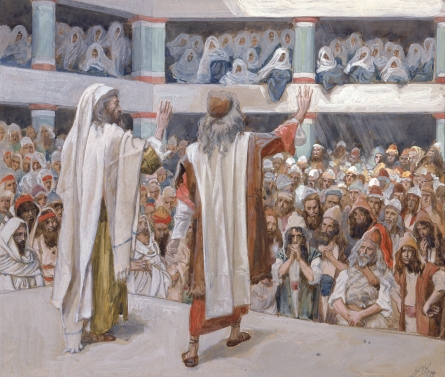
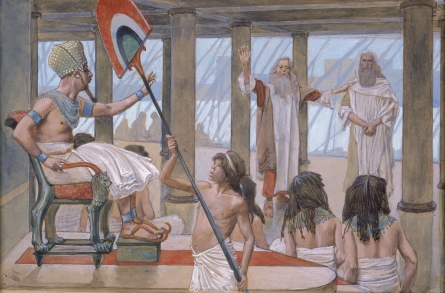
Afterwards, Moses and Aaron went in and told Pharaoh:
— Thus says Yahweh, the God of Israel: “Let My people go, so they may hold a feast for Me in the wilderness.”
But Pharaoh said:
— Who is He, that I should obey His command to let Israel go? I don’t know this Yahweh and I will not let Israel go.
So they said:
— The God of the Hebrews has met with us. Please let us go on a three-day journey into the desert to sacrifice to our God Yahweh, lest He meet us with pestilence or with the sword.
But Pharaoh said:
— Moses and Aaron, why are you trying to get people to stop working? Get back to work! Look, the people of the land are too many now and you’re trying to get them to stop working!
So that day Pharaoh gave the taskmasters of the people and their officials this command:
— You will no longer give straw to the people to make bricks, as you used to. Let them go and gather straw for themselves. But lay on them the same quota of bricks that they made before; don’t reduce it, because they’re lazy. That’s why they say: ‘Let’s go and sacrifice to our God.’ Make the labor harder for these men so that they may work more and pay less attention to false words.
The taskmasters of the people and their officials told the people:
— Thus says Pharaoh: “No straws for you people. Y’all yourselves go and get straw wherever y’all can find it. But your labor will not be reduced.”
So the people went abroad throughout all the land of Egypt to gather stubble for straw. The taskmasters kept pressing them:
— Finish your daily quota the same as when y’all had straw given to y’all!
The Israelite officers, whom Pharaoh’s taskmasters had set over the people, were beaten and were asked:
— Why haven’t you people fulfilled your quota of making bricks as in the past, the third day before and today?
So the Israelite officers came in and cried out to Pharaoh:
— Why are you doing your servants like this? You give us no straw, and they tell us, “Make bricks!” And look, your servants are beaten! It’s your own people’s fault!
Pharaoh said:
— Lazy! That’s what you people are - lazy! You people say, “Let’s go and sacrifice to Yahweh.” Now get back to work! We will not give straw to y’all, and y’all have to meet your quota!
The Israelite officers started seeing themselves in such a bad way, because they were told, “Y’all will not stop making your daily quota of bricks.” So they met Moses and Aaron, who were coming to meet them from their audience with Pharaoh, and told them:
— May God look on y’all and judge y’all! Y’all made us look horrible to Pharaoh and his attendants and put a broadsword in his hands to kill us!
So Moses turned to Yahweh and said:
— O Yahweh, why did You do harm to this people? Why did you send me? When I went to Pharaoh to speak in Your name, he did harm to this people and You didn’t save them!
Then Yahweh spoke to Moses:
— Tell the Israelites to camp, as they turn back, by Pi Hahiroth between Migdol and the Red Sea, opposite Baal Tsephon. You must camp in front of them by the sea. Pharaoh will think, “The Israelites are wandering around confused in the land. The wilderness has them surrounded.” So I will harden Pharaoh’s heart and he’ll pursue them, and I will be glorified by Pharaoh and all his military. Then the Egyptians will know that I am Yahweh.
And they did so.
When the king of Egypt was told that the people have fled, he and his attendants changed their hearts against the people and said:
— What have we done? We’ve let Israel go and stop serving us!
So Pharaoh prepared his chariots, and took all his army with him. He took 600 select chariots, all the horses of the Egyptians, and third-rank generals upon all of them. Yahweh hardened the heart of Pharaoh king of Egypt, and Pharaoh pursued the Israelites, who were marching boldly. The Egyptians pursued them. All the horses and chariots of Pharaoh, his horsemen, and his army overtook them encamping by the sea, beside Pi Hahiroth, before Baal Zephon.
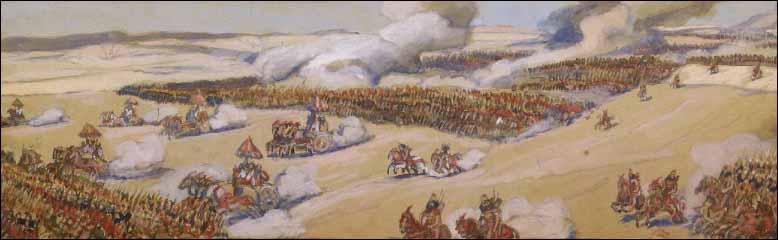
When Pharaoh came near, the Israelites lifted up their eyes and - surprise! - the Egyptians were marching after them. The Israelites were very afraid and cried out to Yahweh. They told Moses:
— Was it because there were no graves in Egypt that you brought us to die in the wilderness? Why have you treated us this way and to bring us out of Egypt? Didn’t we tell you back in Egypt to leave us alone so we could serve the Egyptians? It would have been better for us to serve the Egyptians than to die in the wilderness!
Moses told them:
— Don’t be afraid. Stand still and see the salvation of Yahweh which He will act on your behalf today. For the Egyptians that y’all see today, y’all will never see them again. Yahweh will fight for y’all, and y’all will keep quiet!
Then Yahweh said to Moses:
— Why are you crying out to me? Speak to the Israelites to gather together. And you, lift up your rod and stretch out your hand over the sea and divide it! The Israelites will go into the middle of the sea on dry ground. And look, I’ll harden the heart of Pharaoh, and of all the Egyptians, so that they go after them. I’ll be glorified through Pharaoh, his army, his chariots, and his horsemen. And all the Egyptians will know that I am Yahweh, when I have been glorified through Pharaoh, his chariots and his horsemen.
Then the angel of God, who was in front of the camp of the children of Israel, went from behind them. Then the pillar of cloud went from before them, and stood behind them. He went between the Egyptians and the camp of Israel, and stood there. There was darkness and gloom, and night passed, and they did not meet one another all the night.
Moses stretched out his hand over the sea, and Yahweh made the sea retreat by a strong east wind all night and turned the sea into dry land, and the waters were divided. The Israelites went into the middle of the sea on the dry ground, and the waters were a wall to them on both sides.
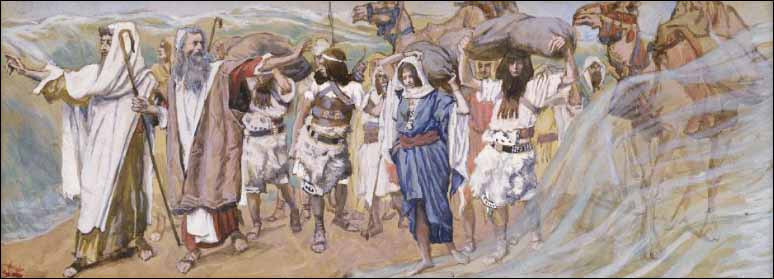
The Egyptians pursued and went in after them into the middle of the sea - all of Pharaoh’s horses, his chariots and his horsemen. In the morning watch, Yahweh looked out on the Egyptian army through the pillar of fire and of cloud and confused the Egyptian army! He caused their chariot wheels to wobble, so that they had difficulty driving.
— Let’s run away from the Israelites, — said the Egyptians — for Yahweh is fighting for them against Egypt!
Yahweh said to Moses:
— Stretch out your hand over the sea, so that the waters may return over the Egyptians, their chariots and their horsemen.
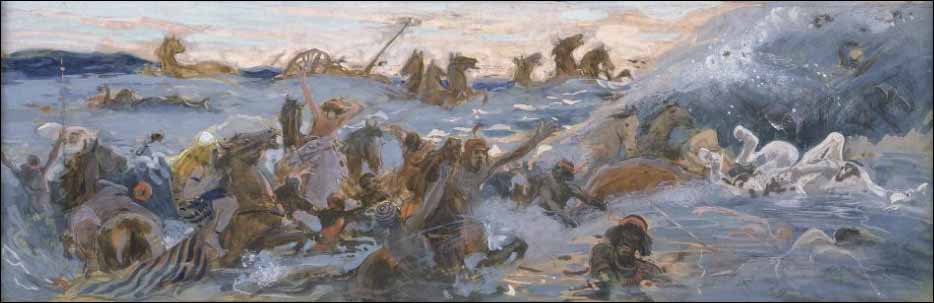
So Moses stretched out his hand over the sea. When morning came, the sea returned to its original state, and while the Egyptians fled against it, Yahweh overthrew the Egyptians in the middle of the sea. The waters returned, and covered the chariots, the horsemen and all the army of Pharaoh that went into the sea after them. There was no one left. But the Israelites went on dry land in the midst of the sea, and the waters were a wall to them on both sides.
So that day Yahweh delivered Israel from the Egyptians, and Israel saw the Egyptians dead on the seashore. And Israel saw the great power that Yahweh acted on the Egyptians. So the people feared Yahweh and believed in God and Moses His servant.
Then Moses and the children of Israel sang this song to Yahweh:
— I will sing to Yahweh, for He has triumphed gloriously.
The horse and his rider He has thrown into the sea.
He is my help and my hiding place, my salvation;
this is my God, and I’ll praise Him;
my father's God, and I’ll exalt Him.
Yahweh who crushes wars -
Yahweh is His name.
Pharaoh's chariots and his army,
He has thrown into the sea,
the chosen third-rank riders;
they are swallowed up in the Red Sea;
the depths He covered them;
they sank into the depths like a stone.
Your right hand, O Yahweh, is glorious in power;
your right hand, O Yahweh, has shattered the enemies.
And in the greatness of Your glory
You have shattered Your adversaries;
You have sent out Your wrath,
and it has consumed them like a reed.
And by the breath of Your anger
the waters were divided;
You ate up the waters like a wall,
You ate up the waves in the midst of the sea.
The enemy said, “I will pursue. I will overtake.
I will divide the plunder.
My desire shall be satisfied on them.
I will draw my sword, my hand shall destroy them.”
You sent out Your spirit, the sea covered them;
they sank like lead in the mighty waters.
Who is like You, Yahweh, among the gods?
Who is like You, glorious in holiness,
fearful in praises, doing wonders?
You stretched out Your right hand.
The earth swallowed them.
You, in Your loving kindness,
have led the people that You have redeemed.
You have guided them in Your strength
to Your holy habitation.
The peoples have heard
and they tremble.
Pangs have taken hold on the inhabitants of Philistia.
Then the chiefs of Edom were dismayed.
Trembling takes hold of the mighty men of Moab.
All the inhabitants of Canaan have melted away.
Terror and dread falls on them.
By the greatness of Your arm they are as still as a stone—
until Your people cross, Yahweh,
until the people You have purchased cross.
You shall bring them in, and plant them
in the mountain of your inheritance,
the place, Yahweh, which You have made for Yourself to live in;
the sanctuary, Yahweh, which Your hands have established.
Yahweh shall reign forever and ever.
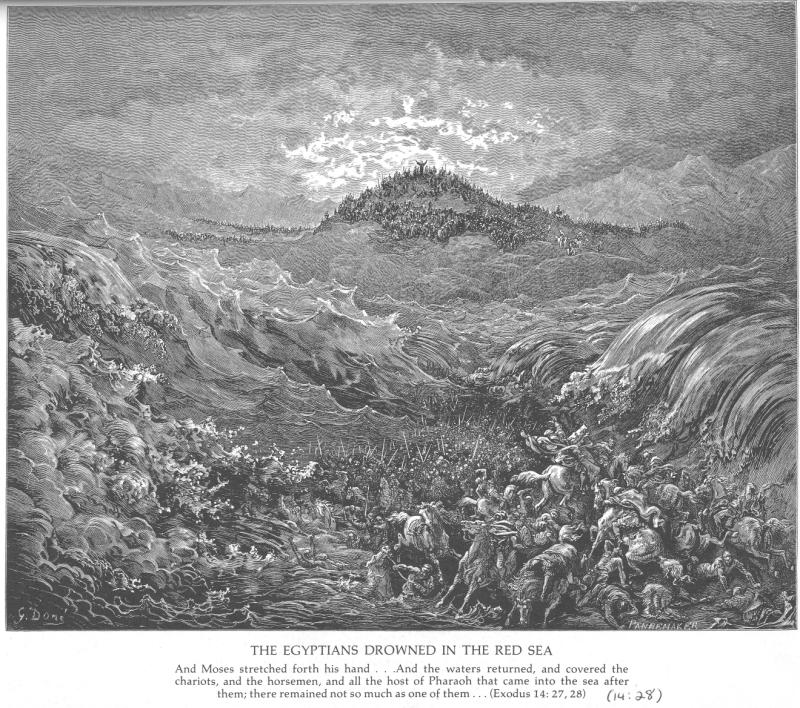
For the horses of Pharaoh went in with his chariots and with his horsemen into the sea, and Yahweh brought back the waters of the sea on them; but the Israelites walked on dry land in the middle of the sea.
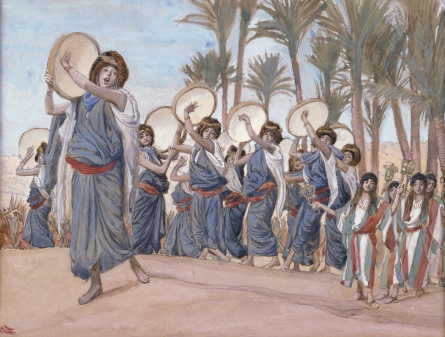
Miriam the prophetess, Aaron’s sister, took a tambourine in her hand, and all the women went out after her with tambourines and with dances. Miriam answered them:
— Sing to Yahweh, for He has triumphed gloriously.
The horse and his rider He has thrown into the sea.
Then Moses brought the Israelites from the Red Sea into the wilderness of Shur. They walked three days in the wilderness, but didn’t find any water to drink. When they came to Marah, they couldn’t drink from the waters of Marah, for they were bitter. Therefore its name was called Marah. The people murmured against Moses, saying:
— What are we gonna drink?
Then Moses cried to Yahweh, and He showed Moses a log. Moses threw it into the waters, and the waters were made sweet. There he made a binding ordinance for them, and there he tested them. He said:
— If y’all really listen to Yahweh your God’s voice, and do what’s right in His eyes, and pay attention to His commandments, and keep all His statutes, I won’t put any of the diseases I’ve placed on the Egyptians on y’all; for I, Yahweh, am your healer.
They came to Elim, where there were 12 springs of water, and 70 palm trees. They encamped there by the waters.
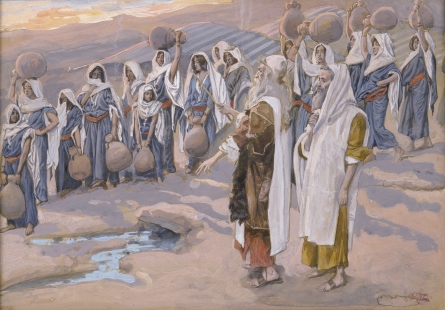
Then all the congregation of the Israelites continued their journey from the Wilderness of Sin, as Yahweh had commanded, and camped in Rephidim, but there was no water for the people to drink. So the people complained to Moses:
— Give us water to drink!
But Moses told them:
— Why are you complaining with me? Why are you testing Yahweh?
So there the people thirsted for water and they complained with Moses:
— Why did you even bring us out of Egypt to kill us, our kids and our livestock of thirst?
So Moses cried out to Yahweh:
— What am I gonna do with these people? A little more and they’re gonna stone me!
Then Yahweh said to Moses:
— Go on before the people and take some of the elders of Israel with you. Take your rod you struck the Nile with in your hand and go. Look, I’ll stand before you there on the rock in Horeb. You’ll strike the rock and water will come out of it, so that the people can drink.
So Moses did this in front of the elders of Israel. Then he named the place Massah and Meribah, because of the contention of the Israelis and because they tested Yahweh, saying:
— Is Yahweh among us or not?
[...]
Translation in progress.